Learning how to improve ACT score starts with understanding your current performance and identifying the subjects where you can gain the most points. Whether your goal is to move from 18 to 24 or push a 30 closer to 34, a focused study plan, regular practice, and careful review of mistakes can help you prepare more effectively.
Want to improve your ACT score and feel more confident on test day? The best way to prepare is to follow a structured study plan, understand your weaknesses, and practice using questions that reflect the current ACT format.
Whether you’re aiming for a few extra points or working toward a score of 30 or higher, consistent preparation can make a meaningful difference.
In this guide, you’ll learn how to improve your ACT score with 10 practical study strategies, section-specific preparation tips, a sample four-week study plan, and free resources to help you prepare.
Learning how to improve ACT score becomes easier when you set a realistic target and track your progress after every practice test.
1. Take a Full-Length ACT Practice Test First
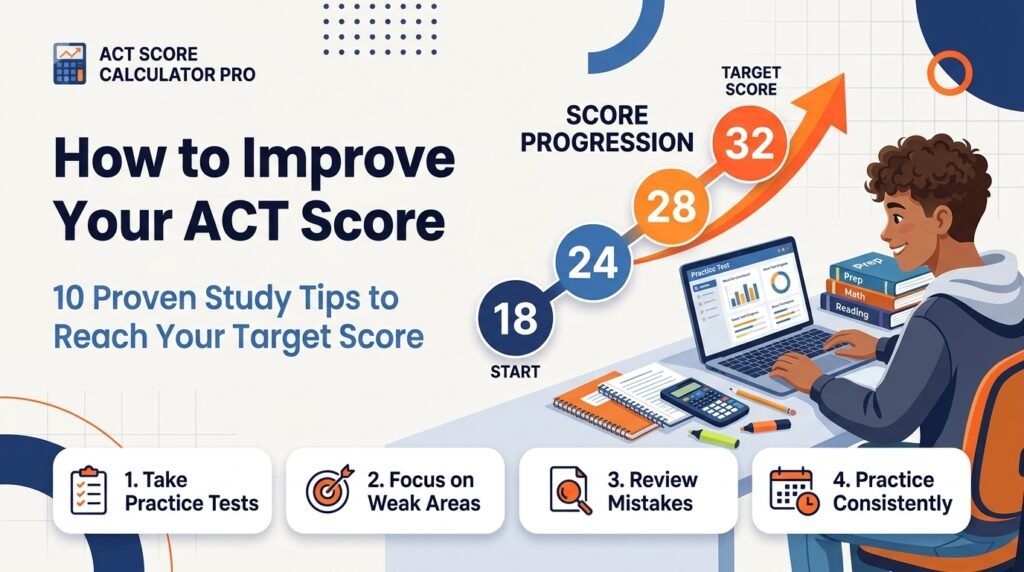
Before starting your preparation, take a full-length ACT practice test under realistic testing conditions.
This gives you a starting point and helps identify the subjects where you need the most improvement.
After completing the test:
- Review your English, Math, and Reading results.
- Identify question types you answered incorrectly.
- Notice where you ran out of time.
- Record the topics that need additional practice.
- Set a realistic target score.
Use an official ACT practice test whenever possible. ACT provides free full-length practice tests, sample questions, and scoring resources.
You can find them on the official ACT free test preparation page.
2. Set a Realistic ACT Score Goal
Once you know your starting score, decide what you want to achieve.
Your target should reflect your current performance, preparation time, and college admission goals.
For example:
| Current ACT score | Suggested target |
|---|---|
| 15 | 18–20 |
| 18 | 21–23 |
| 20 | 23–25 |
| 23 | 26–28 |
| 25 | 28–30 |
| 28 | 30–32 |
| 30 | 32–34 |
These are illustrative study goals, not guaranteed improvements or official ACT benchmarks.
If you currently score 20 and want to reach 26, divide your goal into smaller milestones. Focus on improving individual section performance instead of trying to increase your entire Composite score at once.
Use our free ACT Score Calculator to calculate your current Composite score and track your progress.
3. Focus on Your Weakest ACT Section
One of the most effective ways to improve your ACT score is to identify where you have the greatest opportunity for improvement.
For example, imagine your current scores are:
| Section | Current score |
|---|---|
| English | 25 |
| Math | 19 |
| Reading | 24 |
Math is your lowest-scoring section, so it may deserve more preparation time.
Instead of studying every subject equally, allocate additional practice time to the areas where you need the most improvement.
Review your mistakes and look for patterns. Are you struggling with algebra, grammar rules, reading comprehension, or interpreting information?
Addressing repeated mistakes is usually more useful than simply completing more questions.
A useful first step in learning how to improve ACT score is identifying which question types consistently cause you trouble.
4. Practice English Grammar and Rhetorical Skills
The ACT English section measures your ability to revise and edit written passages.
Important areas to review include:
- Subject-verb agreement
- Punctuation and commas
- Sentence structure
- Verb tense
- Pronoun agreement
- Transitions
- Conciseness and clarity
- Organization and rhetorical purpose
Do not just memorize grammar rules. Practice applying them in short passages and understand why an answer is correct.
When reviewing an incorrect answer, identify the rule or writing principle you missed. Keep a list of recurring mistakes and revisit them during your next study session.
If your goal is to improve ACT score, practise grammar rules, punctuation, sentence structure, and rhetorical skills regularly.
5. Strengthen Your ACT Math Skills
Math preparation requires a combination of concept review, problem-solving practice, and time management.
Focus on important areas such as:
- Algebra
- Functions
- Geometry
- Statistics and probability
- Number systems
- Trigonometry
- Mathematical modeling
Start with the topics you find most difficult. Review the underlying concepts before attempting more challenging questions.
A useful approach is to solve a small set of problems every day. Afterward, review each incorrect answer and work through the solution again without looking at the explanation.
The goal is not just to get the right answer. You should understand the mathematical steps required to reach it.
To improve ACT score in Math, review the concepts behind incorrect answers instead of simply memorising formulas.
6. Improve Reading Speed and Comprehension
The ACT Reading section evaluates how well you understand passages, identify important details, and interpret information.
To improve your reading performance:
- Practice reading different types of passages.
- Identify the main idea before answering questions.
- Pay attention to the author’s purpose and tone.
- Look for supporting evidence in the passage.
- Avoid spending too much time on one difficult question.
- Practice answering questions under timed conditions.
Reading speed matters, but accuracy is equally important.
Rather than rushing through passages, practice locating relevant information efficiently and understanding what each question is asking.
Students looking to improve ACT score should practise finding evidence in passages and answering questions within the time limit.
7. Use Official ACT Practice Questions
Not all practice materials accurately reflect the current ACT format.
Whenever possible, use official ACT practice tests and questions. They help you become familiar with the question styles, timing, and expectations of the actual exam.
ACT provides free resources including:
- Full-length practice tests
- Subject-specific sample questions
- Practice quizzes
- Test preparation guides
- Scoring information
Visit the official ACT practice questions page.
You can also access the official ACT test preparation resources for additional study options.
8. Learn to Manage Your Time
Knowing the material is important, but you also need to complete questions within the available time.
Practice with a timer so that you become comfortable working under exam conditions.
A few useful strategies include:
- Read instructions carefully before starting.
- Avoid spending too long on one question.
- Move forward when you are stuck and return if time allows.
- Watch your remaining time throughout the section.
- Answer every question because there is no penalty for guessing.
- Practice with the same timing as your intended test format.
Remember that practice conditions should reflect the version of the ACT you are scheduled to take.
9. Review Every Mistake
Completing practice questions is only part of the preparation process. Reviewing your mistakes is where much of the learning happens.
Create a simple error log with three columns:
| Question or topic | Why you got it wrong | What to review |
|---|---|---|
| Algebra | Misunderstood the equation | Linear equations |
| Grammar | Incorrect punctuation | Comma rules |
| Reading | Missed supporting evidence | Passage analysis |
Review this log regularly.
If you repeatedly make the same type of mistake, spend additional time understanding the concept before moving to more practice questions.
Do not simply memorize the correct answer. Learn how to recognize and solve similar questions in the future.
10. Prepare for Test Day in Advance
Your preparation should include more than academic study.
In the days leading up to your ACT:
- Review important concepts instead of learning everything from scratch.
- Complete your final timed practice session early enough to review it.
- Confirm your test registration and test location.
- Check the current ACT rules for permitted materials and identification.
- Get sufficient sleep.
- Eat a normal meal before your test.
- Arrive with enough time to complete check-in.
Avoid trying to study everything the night before. A calm and organized approach can help you perform closer to your actual preparation level.
Good time management and a calm approach can help you improve ACT score by avoiding unnecessary mistakes.
A Four-Week ACT Study Plan
If your test date is approaching, a structured four-week schedule can help you organize your preparation.
| Week | Main focus | Suggested activities |
|---|---|---|
| Week 1 | Assessment | Take a practice test and identify weak areas |
| Week 2 | Subject improvement | Focus on English, Math, and Reading weaknesses |
| Week 3 | Timed practice | Complete timed sections and review mistakes |
| Week 4 | Final preparation | Take another practice test and review key concepts |
Try to study consistently rather than completing all your preparation in a few long sessions.
Adjust the schedule according to your available time and starting score. If you have several months, spread the same activities over a longer period.
A realistic weekly plan can help you improve ACT score without feeling overwhelmed by your preparation.
Should You Practice the Optional ACT Science Section?
Science is optional under the current ACT format and is not included in the Composite score for tests taken from September 2025 onward.
However, some colleges or programs may consider or require Science results. Check the testing requirements of your preferred institutions before deciding whether to take it.
If you choose Science, focus on:
- Reading graphs and tables
- Interpreting experimental results
- Understanding scientific arguments
- Identifying relationships between variables
- Evaluating data and evidence
The optional Writing test is also separate from the Composite score. Check college requirements before deciding whether to take it.
How Much Can You Improve Your ACT Score?
There is no guaranteed number of points you can gain from studying.
Your improvement depends on your starting performance, preparation time, study methods, and familiarity with the test.
Some students may see progress after a few weeks, while others need several months of consistent practice.
The most useful way to measure improvement is to compare practice test results over time using comparable test formats and testing conditions.
Track your section scores as well as your Composite score so you can identify where your preparation is working.
Frequently Asked Questions About Improving Your ACT Score
1. How can I improve my ACT score quickly?
Start by taking a practice test and identifying your weakest sections. Focus on recurring mistakes, practice official questions, and complete timed exercises. Prioritizing your biggest weaknesses is more effective than studying randomly.
2. How many hours should I study for the ACT each day?
There is no universal daily study requirement. A consistent schedule of focused study sessions can be more useful than occasional long sessions. Adjust your study time according to your test date and preparation needs.
3. Can I improve my ACT score in one month?
Yes, improvement is possible in one month, although results vary. Focus on your weakest subjects, review mistakes, and complete timed practice sections throughout the month.
4. Is a 30 on the ACT difficult to achieve?
A 30 is a strong ACT Composite score and requires solid performance across English, Math, and Reading. The difficulty depends on your starting point and preparation.
5. Are official ACT practice tests free?
Yes. ACT provides free official full-length practice tests and subject-specific sample questions through its website.
6. Should I study every ACT subject equally?
Not necessarily. Start by identifying your weakest sections and allocate more preparation time to those areas. Continue practicing your stronger subjects so your performance remains consistent.
7. Does taking more practice tests improve your ACT score?
Practice tests can help you become familiar with the exam and identify areas for improvement. However, reviewing mistakes and understanding the concepts behind them is just as important as completing the tests.
8. How often should I retake the ACT?
Your retake schedule should depend on your preparation, college deadlines, and testing availability. Consider retaking the test when you have addressed weaknesses and are consistently reaching your target score in practice.
Final Thoughts: Build a Study Plan and Track Your Progress
Improving your ACT score takes preparation, consistency, and a clear understanding of your strengths and weaknesses.
Start with a practice test, set a realistic goal, and focus on the subjects where you need the most improvement. Use official ACT practice questions and review your mistakes after every study session.
A consistent routine is one of the most effective ways to improve ACT score over time. Remember that the best strategy to improve ACT score is consistent preparation based on your individual weaknesses.
When you are ready, use our free ACT Score Calculator to calculate your Composite score and compare your results.
You can also explore these resources:
Official ACT preparation resources: