ACT Score Range: Understanding Scores from 1 to 36
The ACT score range runs from 1 to 36, with 36 being the highest possible score. Students receive individual scores for English, Math, and Reading, which are used to calculate their overall Composite score. Science is optional under the enhanced ACT format, and Writing is reported separately when taken.
Understanding the ACT score range can help you evaluate your performance, compare your results with other students, and set realistic goals for college admissions.
In this guide, we’ll explain the ACT scoring scale, the meaning of different score ranges, how Composite scores are calculated, and what your results tell you.
What Is the ACT Score Range?
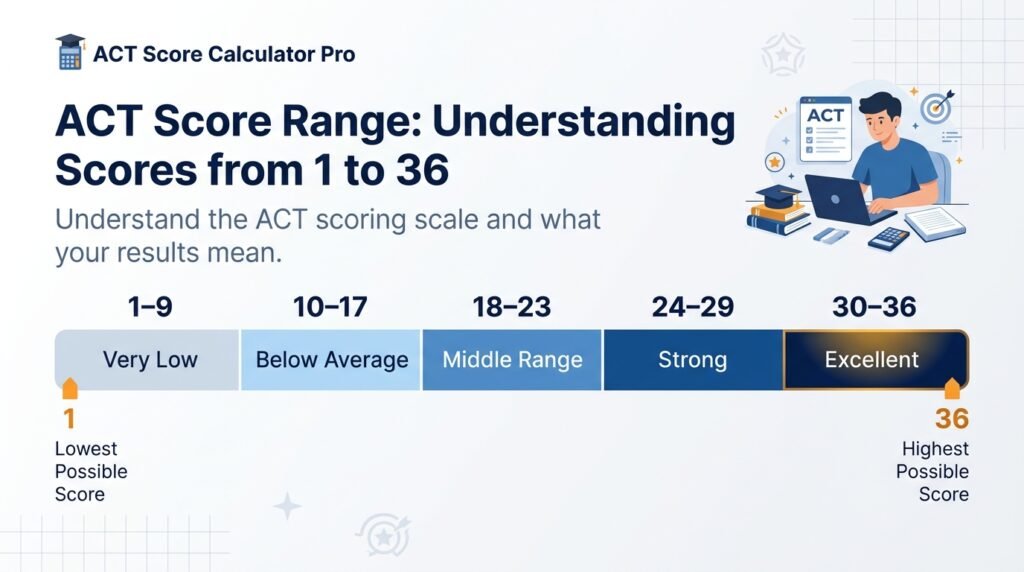
The ACT uses a scale from 1 to 36 for its multiple-choice section scores and Composite score.
A score of 1 is the lowest reported score, while 36 is the highest possible score. Your section scores are based on your performance in the individual test subjects.
The current ACT includes these scoring components:
| ACT score category | Score range |
|---|---|
| English | 1–36 |
| Math | 1–36 |
| Reading | 1–36 |
| Science (optional) | 1–36 |
| Composite | 1–36 |
| Writing (optional) | 2–12 |
The Composite score is calculated using English, Math, and Reading. Science is reported separately if you take that section. Writing is also reported separately and does not affect the Composite score.
ACT Score Range Breakdown: What Different Scores Mean
Although every ACT score falls somewhere between 1 and 36, different score levels can indicate different levels of academic performance.
The following ranges are general descriptions to help students interpret their results. They are not official ACT performance categories or college admission cutoffs.
| ACT score range | General interpretation |
|---|---|
| 1–9 | Very low score range; significant improvement may be helpful |
| 10–17 | Below-average score range |
| 18–23 | Around the middle of the scoring scale |
| 24–29 | Strong score range |
| 30–36 | Very strong to exceptional score range |
Your score should always be considered alongside your academic record, college goals, and the admission requirements of individual institutions.
Scores from 1 to 9
Scores in this range indicate that a student may benefit from additional preparation and practice. Reviewing foundational skills in English, mathematics, and reading can help identify areas that need improvement.
Scores from 10 to 17
This range reflects developing performance. Students may want to focus on the sections where they lost the most points and build a structured study plan before retaking the test.
Scores from 18 to 23
Scores in this range are around the middle of the ACT scoring scale. Depending on the college, program, and admission requirements, students may have several postsecondary options.
Scores from 24 to 29
A score in this range can be competitive at many colleges. Students applying to selective programs should compare their results with the published score ranges of their target institutions.
Scores from 30 to 36
This is a strong to exceptional score range. A score closer to 36 generally reflects very high performance among ACT test takers. However, admission decisions also depend on grades, coursework, essays, and other application factors.
How Is the ACT Composite Score Calculated?
For tests taken in September 2025 or later, the ACT Composite score is calculated by averaging three section scores:
- English
- Math
- Reading
The average is rounded to the nearest whole number. Fractions below 0.5 are rounded down, while fractions of 0.5 or higher are rounded up.
Example:
Suppose your section scores are:
| Section | Score |
|---|---|
| English | 25 |
| Math | 28 |
| Reading | 27 |
The calculation is:
(25 + 28 + 27) ÷ 3 = 26.67
Your final ACT Composite score is 27.
You can use our free ACT Score Calculator to calculate your Composite score using your section results.
Did the ACT Composite Score Range Change?
The ACT scoring scale itself remains 1–36, but the Composite calculation changed in 2025.
| Test period | Sections used for Composite |
|---|---|
| Before September 2025 | English, Math, Reading, and Science |
| September 2025 onward | English, Math, and Reading |
Science became optional under the enhanced ACT format and is no longer included in the current Composite calculation.
This distinction matters when comparing older ACT score reports with newer results. A previous Composite score is not recalculated using the new formula.
What Is the Highest Possible ACT Score?
The highest possible ACT Composite score is 36.
Students can also earn a maximum score of 36 in each multiple-choice section:
- English: 36
- Math: 36
- Reading: 36
- Science: 36, if taken
A perfect Composite score requires an average of 36 across English, Math, and Reading.
A score of 36 is an exceptional achievement, but students should remember that colleges consider many factors beyond standardized test results.
What Is the Lowest Possible ACT Score?
The lowest reported ACT scale score is 1.
This applies to the Composite score and the individual multiple-choice section scores. The Writing test uses a separate scale from 2 to 12.
A lower score does not mean a student cannot improve. Reviewing score reports, identifying weaker subjects, and preparing strategically can help students work toward a higher result.
Does the ACT Writing Score Affect the Composite?
No. The optional ACT Writing score does not affect the Composite score.
Writing is reported separately on a scale of 2–12. Students who take the Writing test receive a score based on four writing domains:
- Ideas and Analysis
- Development and Support
- Organization
- Language Use and Conventions
Check the requirements of your preferred colleges before deciding whether to take the optional Writing test.
How to Understand Your ACT Score Report
Your ACT score report provides more information than just your Composite score.
Depending on your test format and the sections you completed, your report may include:
- Composite score
- English score
- Math score
- Reading score
- Science score, if taken
- STEM score, when eligible
- Writing score, if taken
- National rank information
To understand where your results stand nationally, visit our ACT Score Percentiles guide.
You can also explore the ACT Score Chart for a detailed look at the 1–36 scale.
Frequently Asked Questions About the ACT Score Range
1. What is the ACT score range?
The ACT Composite and multiple-choice section scores range from 1 to 36. The optional Writing test uses a separate scale from 2 to 12.
2. Is 36 the highest ACT score?
Yes. A Composite score of 36 is the highest possible ACT score. Students can also earn a 36 in individual multiple-choice sections.
3. Is 20 a good ACT score?
A score of 20 is around the middle of the ACT scoring scale. Whether it is a good score depends on your college goals, the institutions you are applying to, and their admission requirements.
Read our guide to Good ACT Scores for a more detailed explanation.
4. Does the ACT score range change every year?
No. The ACT scoring scale remains 1–36. However, ACT may update test formats and scoring procedures, so students should check the rules that apply to their test date.
5. Is Science included in the ACT Composite score?
For tests taken from September 2025 onward, Science is optional and is not included in the Composite calculation. The Composite is based on English, Math, and Reading.
6. What is the ACT Writing score range?
The optional ACT Writing test is scored from 2 to 12. It is reported separately and does not affect the Composite score.
7. How many questions do I need to answer correctly to get a 30 on the ACT?
There is no single fixed number of correct answers that guarantees a 30. ACT converts raw scores into scaled scores using test-specific conversion procedures. The conversion can vary between test forms.
8. Where can I calculate my ACT Composite score?
You can use our free ACT Score Calculator to estimate your Composite score from your English, Math, and Reading results.
Calculate Your ACT Score and Explore More Guides
Understanding the ACT score range is the first step toward evaluating your test performance. Once you know your Composite and section scores, you can compare your results with national rankings and the expectations of your target colleges.
Use our free ACT Score Calculator to calculate your Composite score, explore the ACT Score Chart, and review our Average ACT Score guide to see how your results compare.
Official ACT resources: