Average ACT Score in 2026: National Average and Score Trends
The average ACT score in the United States for the 2026 graduating class was 19.2 out of 36. This figure represents the Composite score of students who graduated in 2026 and took the ACT at least once during high school.
Understanding the average ACT score can help you evaluate your own performance, set a realistic target for your next test, and compare your results with other students nationwide.
The average is only a starting point. Colleges have different admission requirements, and a score that is above average nationally may not be competitive at every university.
Use our free ACT Score Calculator to estimate your Composite score from your English, Math, and Reading results.
What Is the Average ACT Score in 2026?
The average ACT Composite score for the 2026 U.S. graduating class was 19.2.
Approximately 1.46 million students in the 2026 graduating class took the ACT. ACT’s report includes each student’s most recent test results, rather than simply counting every test attempt.
| Statistic | 2026 |
|---|---|
| Average ACT Composite | 19.2 |
| Average English | 18.2 |
| Average Math | 19.0 |
| Average Reading | 19.8 |
| Average Science | 19.4 |
| Average STEM | 19.4 |
| Students who took the ACT | 1,463,293 |
Science is optional under the current ACT format. The current Composite is calculated using English, Math, and Reading, while Science is reported separately. STEM is calculated using Math and Science for students who take Science.
The average ACT score is useful for understanding national performance, but your college goals should determine the score you aim for.
Average ACT Scores by Section in 2026
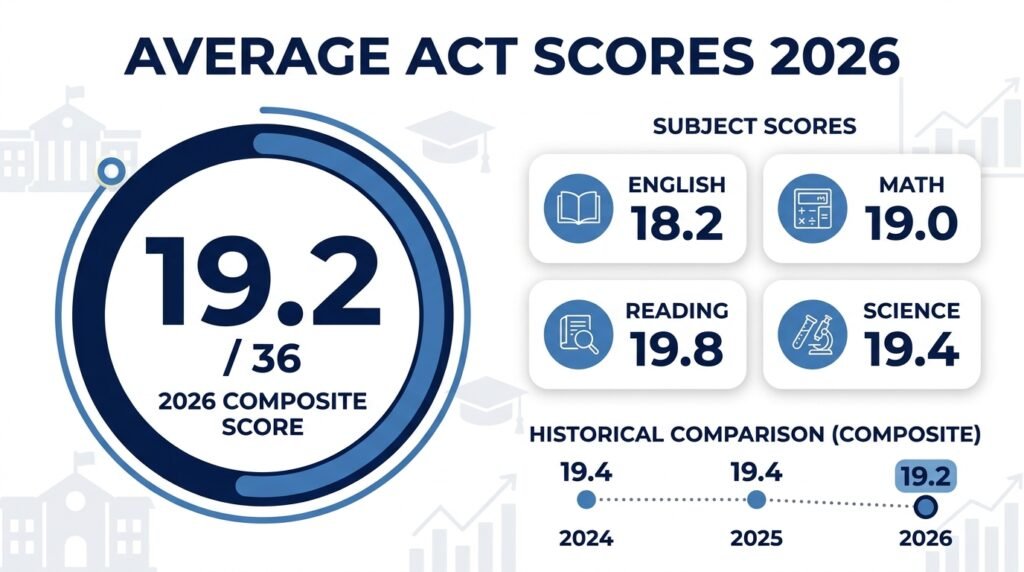
ACT reports average scores for individual subject areas. These averages can help students identify how their performance compares nationally.
| ACT Section | Average Score | Score Scale |
|---|---|---|
| English | 18.2 | 1–36 |
| Math | 19.0 | 1–36 |
| Reading | 19.8 | 1–36 |
| Science | 19.4 | 1–36 |
| Composite | 19.2 | 1–36 |
Reading had the highest average among the three sections used to calculate the current Composite, while English had the lowest.
Average ACT English Score
The national average ACT English score for the 2026 graduating class was 18.2.
English tests grammar, punctuation, sentence structure, rhetorical skills, and your ability to understand how language works within a passage.
If your English score is below the national average, practice identifying grammatical errors, understanding sentence relationships, and evaluating how authors organize ideas.
Average ACT Math Score
The average ACT Math score in 2026 was 19.0.
The Math section tests mathematical concepts and problem-solving skills across topics including algebra, geometry, statistics, and other areas.
Students looking to improve their Math score should review foundational concepts, practice solving questions efficiently, and pay attention to mistakes made during timed tests.
Average ACT Reading Score
The average ACT Reading score in 2026 was 19.8.
Reading measures comprehension, the ability to identify main ideas, interpret details, analyze relationships, and draw conclusions from written passages.
Reading was the highest average among the three sections included in the current Composite calculation.
Average ACT Science Score
The average ACT Science score for students who took the optional Science section in the 2026 graduating class was 19.4.
Science questions focus on interpreting data, evaluating scientific information, understanding experiments, and analyzing relationships between variables.
Science is no longer required for the current ACT Composite score. Students who take it receive a separate Science score and may also receive a STEM score.
Average ACT STEM Score
The average STEM score for the 2026 graduating class was 19.4 among students who took both Math and Science.
The STEM score reflects performance across Math and Science and can provide additional information about a student’s strengths in science-related subjects.
Average ACT Score by Year
The national average ACT Composite has remained relatively stable over recent graduating classes.
| Graduating Class | Average Composite |
|---|---|
| 2024 | 19.4 |
| 2025 | 19.4 |
| 2026 | 19.2 |
The average declined by 0.2 points between the 2025 and 2026 graduating classes.
When comparing averages across years, remember that the ACT changed its Composite scoring structure beginning with tests administered in September 2025. Current Composite scores use English, Math, and Reading, while older Composite scores included Science.
Historical averages should therefore be interpreted with the scoring changes in mind.
Average ACT Score by Section: 2024–2026
The table below shows how national section averages have changed over the past three graduating classes.
| Graduating Class | English | Math | Reading | Composite |
|---|---|---|---|---|
| 2024 | 18.6 | 19.0 | 20.1 | 19.4 |
| 2025 | 18.4 | 18.9 | 20.0 | 19.4 |
| 2026 | 18.2 | 19.0 | 19.8 | 19.2 |
English and Reading averages declined slightly over this period, while Math remained close to 19.
These figures reflect ACT-tested graduates and their most recent reported scores. They are not averages of every individual test attempt.
What Is the Median ACT Score?
The average and median ACT scores are different statistics.
The average is calculated by adding scores and dividing by the number of students. The median is the middle score when all scores are arranged from lowest to highest.
For the 2026 graduating class, the median Composite score was 18. The middle 50% of students scored approximately between 14 and 23.
This means the average of 19.2 is slightly higher than the median. The difference occurs because the distribution of scores is not perfectly symmetrical.
The median can be useful because it represents the middle test taker rather than being influenced as much by unusually high or low scores.
How Does Your ACT Score Compare With the Average?
Compare your ACT Composite score with the 2026 national average of 19.2.
| Your Composite Score | Comparison With Average |
|---|---|
| 14 or below | Below the middle 50% range |
| 15–18 | Below the national average |
| 19–20 | Around the national average |
| 21–23 | Above average |
| 24–27 | Strong performance |
| 28–31 | Very strong performance |
| 32–36 | Exceptional performance |
These ranges are general interpretations, not official ACT classifications. Your national rank and college admission requirements provide more detailed context.
For example, a score of 24 is above the national average and has a national rank of 80 in the 2026–2027 ACT reference.
Visit our ACT Score Chart to see how Composite scores from 1 to 36 are interpreted.
Average ACT Score vs. a Good ACT Score
The average ACT score represents the performance of the national test-taking population. A good ACT score depends on the student and their college goals.
A score near 19 may be average nationally, but it could be sufficient for some colleges. Students applying to more selective universities may need scores in the mid-20s, upper 20s, or 30s.
Consider these general examples:
| ACT Composite | General Interpretation |
|---|---|
| 19 | Around the national average |
| 21 | Above average |
| 24 | Strong |
| 28 | Very strong |
| 30 | Excellent |
| 32+ | Exceptional |
The best way to determine whether your score is competitive is to compare it with the ACT score ranges reported by the colleges you are interested in.
Read our full guide to Good ACT Scores for more detailed comparisons.
Average ACT Scores by State
Average ACT scores can vary significantly by state. However, these differences should not automatically be interpreted as differences in student ability.
Some states have widespread ACT participation because the test is offered to students through school or district programs. Other states have lower participation, with a greater share of students taking the test because they are applying to colleges that require or consider standardized testing.
Participation rates can affect state averages. A state where nearly every student takes the ACT may have a different average than a state where only a smaller group of college-bound students takes it.
ACT provides state-level data through its annual graduating-class reports and research dashboards.
When comparing states, consider:
- Percentage of high school graduates who took the ACT
- Whether the ACT was offered statewide during school hours
- Number of students included in the data
- College-going rates
- Changes in testing requirements and participation
- Whether scores represent the most recent test or another reporting measure
For the most accurate state comparisons, use the official ACT state data rather than comparing figures from different years or unrelated sources.
What Is the Average ACT Score for College Admission?
The national average is not a college admission cutoff.
Universities establish their own admission policies and may consider ACT scores alongside high school grades, coursework, extracurricular activities, essays, recommendations, and other information.
A score of 19.2 may be around the national average, but a student’s competitiveness depends on the college they are applying to.
To set an admission target:
- Make a list of colleges you are interested in.
- Find each college’s published ACT score range for admitted students.
- Compare your Composite score with the middle 50% range.
- Consider whether your score is within or above the range.
- Decide whether retaking the ACT could strengthen your application.
Remember that some colleges are test-optional or test-blind, and their policies can change. Always review current admissions information directly from the institution.
What ACT Score Should You Aim For?
Your target ACT score should be based on your college goals and current performance.
If you currently score around 19, aiming for 21–23 may be a realistic next step. If you already score in the mid-20s, you may want to target the upper 20s or 30s, depending on your colleges.
A useful strategy is to set three targets:
Baseline goal: A score you can reasonably achieve based on your current practice tests.
Target goal: The score you would like to achieve for your college applications.
Stretch goal: A higher score that could strengthen your application or potentially improve scholarship opportunities.
Use practice tests to monitor your progress and adjust your preparation plan.
How to Improve Your ACT Score
If your ACT score is below the national average or below your target, there are several ways to improve.
1. Identify Your Weakest Section
Compare your English, Math, and Reading scores. Determine which section has the greatest opportunity for improvement.
2. Practice With Timed Questions
The ACT requires students to work efficiently. Timed practice can help you improve pacing and reduce the chance of leaving questions unanswered.
3. Review Every Mistake
Don’t just check whether an answer was right or wrong. Understand why you made the mistake and how to solve similar questions correctly.
4. Focus on Your Target Score
Use the score ranges of your preferred colleges to establish a meaningful goal rather than simply trying to increase your score by one point.
5. Track Your Practice Results
Record your practice test Composite and section scores. Reviewing your progress over several weeks can help you determine whether your preparation is working.
Use our ACT Score Calculator after each practice test to estimate your Composite score.
Frequently Asked Questions About the Average ACT Score
What is the average ACT score in 2026?
The average ACT Composite score for the 2026 U.S. graduating class was 19.2 out of 36.
Is 19 a good ACT score?
A 19 is close to the 2026 national average of 19.2. Whether it is good for college admission depends on the institutions you are considering.
Is 20 an average ACT score?
A 20 is slightly above the 2026 national average of 19.2 and is a solid score compared with the national test-taking population.
What is the average ACT Math score?
The average ACT Math score for the 2026 graduating class was 19.0.
What is the average ACT English score?
The average ACT English score for the 2026 graduating class was 18.2.
What is the average ACT Reading score?
The average ACT Reading score for the 2026 graduating class was 19.8.
What is the average ACT Science score?
The average Science score for students who took Science in the 2026 graduating class was 19.4. Science is optional under the current ACT format.
Has the average ACT score changed?
The national Composite average was 19.4 for the 2024 and 2025 graduating classes and 19.2 for the 2026 graduating class.
What is the highest possible ACT score?
The highest possible ACT Composite score is 36. The individual section scores also range from 1 to 36.
How can I check my ACT score?
You can check your ACT score through your official MyACT account. If you already have your section scores, you can use our calculator to estimate your Composite score.
Final Thoughts
The average ACT Composite score for the 2026 graduating class was 19.2. This gives students a useful benchmark for comparing their results with the national test-taking population.
However, the average is not necessarily the score you should aim for. Your target should depend on your college list, academic goals, and current practice-test performance.
Compare your score with the national averages, explore the ACT Score Percentiles chart, and use the ACT Score Calculator to estimate your Composite score.