ACT score percentiles show how your performance compares with other students who have taken the ACT. Your percentile rank tells you what percentage of test takers earned the same score or a lower score.
For example, an ACT Composite score with a national rank of 80 means you scored as high as or higher than approximately 80% of recent ACT test takers.
Use the ACT score percentile chart below to compare scores from 1 to 36, understand national rankings, and see how your results compare across individual test sections.
You can also use our free ACT Score Calculator to calculate your Composite score before checking your percentile.
This ACT score percentile chart helps students quickly identify their national ranking for each Composite score from 1 to 36.
ACT Score Percentile Chart (1–36)
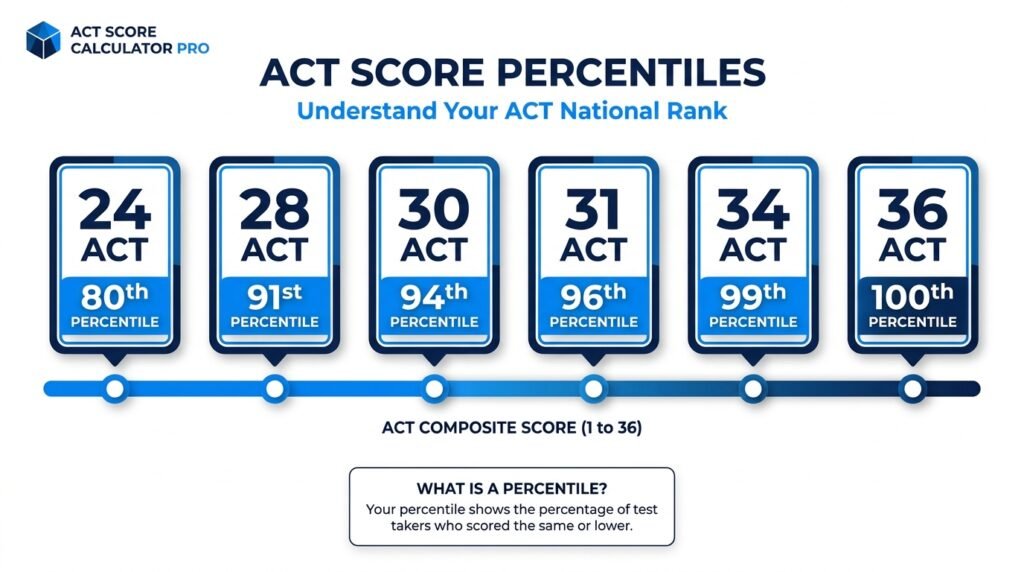
The following table shows the 2026–2027 ACT national ranks for Composite, English, Math, Reading, Science, and STEM scores.
The national ranks indicate the percentage of recent ACT-tested high school graduates who earned the same score or a lower score. The figures are based on ACT-tested graduates from 2024, 2025, and 2026 and apply to tests taken from September 2026 through August 2027.
| Score | Composite | English | Math | Reading | Science | STEM |
|---|---|---|---|---|---|---|
| 36 | 100 | 100 | 100 | 100 | 100 | 100 |
| 35 | 99 | 99 | 99 | 98 | 99 | 99 |
| 34 | 99 | 97 | 99 | 97 | 99 | 99 |
| 33 | 98 | 96 | 98 | 95 | 98 | 98 |
| 32 | 97 | 95 | 97 | 93 | 97 | 97 |
| 31 | 96 | 94 | 96 | 91 | 96 | 96 |
| 30 | 94 | 93 | 95 | 89 | 95 | 95 |
| 29 | 93 | 92 | 94 | 87 | 93 | 94 |
| 28 | 91 | 90 | 93 | 85 | 92 | 92 |
| 27 | 89 | 88 | 91 | 83 | 91 | 90 |
| 26 | 86 | 87 | 88 | 81 | 89 | 88 |
| 25 | 83 | 84 | 84 | 78 | 86 | 85 |
| 24 | 80 | 81 | 81 | 75 | 82 | 81 |
| 23 | 77 | 77 | 77 | 71 | 77 | 77 |
| 22 | 72 | 74 | 74 | 66 | 70 | 73 |
| 21 | 68 | 70 | 71 | 61 | 65 | 69 |
| 20 | 63 | 64 | 68 | 56 | 60 | 64 |
| 19 | 58 | 58 | 64 | 51 | 54 | 58 |
| 18 | 52 | 54 | 60 | 47 | 48 | 52 |
| 17 | 47 | 50 | 53 | 42 | 41 | 45 |
| 16 | 41 | 46 | 45 | 37 | 34 | 36 |
| 15 | 34 | 41 | 33 | 33 | 27 | 27 |
| 14 | 28 | 34 | 21 | 28 | 19 | 17 |
| 13 | 20 | 28 | 11 | 22 | 14 | 10 |
| 12 | 13 | 23 | 6 | 16 | 10 | 5 |
| 11 | 6 | 18 | 3 | 10 | 6 | 2 |
| 10 | 2 | 11 | 2 | 5 | 3 | 1 |
| 9 | 1 | 6 | 1 | 2 | 2 | 1 |
| 8 | 1 | 3 | 1 | 1 | 1 | 1 |
| 7 | 1 | 2 | 1 | 1 | 1 | 1 |
| 6 | 1 | 1 | 1 | 1 | 1 | 1 |
| 5 | 1 | 1 | 1 | 1 | 1 | 1 |
| 4 | 1 | 1 | 1 | 1 | 1 | 1 |
| 3 | 1 | 1 | 1 | 1 | 1 | 1 |
| 2 | 1 | 1 | 1 | 1 | 1 | 1 |
| 1 | 1 | 1 | 1 | 1 | 1 | 1 |
Note: These are ACT national ranks, commonly described as percentile rankings. They are specific to the 2026–2027 reference period. ACT updates its comparison groups and national ranks, so always check the reporting year when comparing scores.
What Is an ACT Percentile?
An ACT percentile, also called a national rank, indicates how your score compares with the scores of other students who took the ACT.
A percentile is not the percentage of questions you answered correctly. Instead, it shows the proportion of the comparison group that earned the same score or a lower score.
For example:
- 90th percentile: Your score is as high as or higher than approximately 90% of test takers.
- 75th percentile: Your score is as high as or higher than approximately 75% of test takers.
- 50th percentile: Your score is around the middle of the comparison group.
- 25th percentile: Approximately 25% of test takers earned the same score or a lower score.
A higher percentile generally indicates stronger performance compared with other ACT test takers.
Understanding your ACT score percentile can help you evaluate your performance against other students across the country.
What ACT Score Is in the 90th Percentile?
For the 2026–2027 ACT national rank reference, a Composite score of 28 corresponds to the 91st percentile. This means a score of 28 is higher than or equal to approximately 91% of the comparison group.
Here are some useful Composite score benchmarks:
| ACT Composite Score | National Rank |
|---|---|
| 24 | 80th percentile |
| 27 | 89th percentile |
| 28 | 91st percentile |
| 29 | 93rd percentile |
| 30 | 94th percentile |
| 31 | 96th percentile |
| 32 | 97th percentile |
| 33 | 98th percentile |
| 34 | 99th percentile |
| 35 | 99th percentile |
| 36 | 100th percentile |
These rankings help students understand how different Composite scores compare nationally.
What ACT Score Is in the 95th Percentile?
A Composite score of 31 corresponds to the 96th percentile in the 2026–2027 national rank table.
This means your score is as high as or higher than approximately 96% of the recent ACT comparison group.
Students targeting highly selective colleges may use this range as one reference point when setting their testing goals. However, college admission decisions depend on more than ACT scores alone.
What ACT Score Is in the 99th Percentile?
A Composite score of 34 corresponds to the 99th percentile in the current ACT national rank table.
Scores of 35 and 36 also fall within the 99th and 100th percentile rankings, respectively.
A score in this range represents very strong performance compared with recent ACT test takers.
ACT Score vs. Percentile: What Is the Difference?
An ACT score and an ACT percentile measure two different things.
Your ACT score is the scaled result you receive for a test section or the overall Composite. It ranges from 1 to 36.
Your percentile indicates how that score compares with the scores of other test takers.
For example, consider a student with an ACT Composite score of 30.
- ACT Composite score: 30
- National rank: 94
- Interpretation: The student’s score is as high as or higher than approximately 94% of the comparison group.
A score of 30 is the actual test result. The 94th percentile provides context about how that result compares nationally.
An ACT score percentile provides useful context because it shows how your Composite score compares with the national test-taking population.
ACT Section Percentiles Explained
ACT national ranks are available for individual sections as well as the Composite score.
This is useful because students can perform differently across English, Math, Reading, and Science.
For example, the 2026–2027 national rank table shows that a score of 24 corresponds to:
- English: 81st percentile
- Math: 81st percentile
- Reading: 75th percentile
- Science: 82nd percentile
- Composite: 80th percentile
- STEM: 81st percentile
The same scaled score can have different national ranks depending on the section. This happens because performance distributions differ across test sections.
Reviewing individual section percentiles can help you identify your stronger areas and decide where additional preparation may be useful.
Your ACT score percentile may differ across English, Math, Reading, and Science, even when the scaled scores are identical.
How Is the ACT Composite Score Calculated?
For ACT tests taken in September 2025 or later, the Composite score is calculated using three required multiple-choice sections:
- English
- Math
- Reading
ACT averages these three section scores and rounds the result to the nearest whole number.
For example, if your scores are:
- English: 26
- Math: 24
- Reading: 25
Your Composite score is:
(26 + 24 + 25) ÷ 3 = 25
Your resulting Composite score is 25.
Science is optional and does not contribute to the current Composite score. Students who take Science can also receive a STEM score based on Math and Science.
If you want to understand the scoring scale in more detail, visit our ACT Score Chart page.
How Do Colleges Use ACT Percentiles?
Colleges may use ACT scores as one part of their admission evaluation. Percentiles can help applicants understand how competitive their scores are compared with other students.
When researching colleges, look for the middle 50% ACT score range for admitted students. This range represents the scores between the 25th and 75th percentiles of enrolled or admitted students, depending on how the college reports its data.
You can use this information in a few ways:
- Reach schools: Your ACT score is below the college’s typical middle 50% range.
- Match schools: Your score falls within the college’s middle 50% range.
- Likely schools: Your score is above the college’s typical middle 50% range.
These categories are only planning guidelines. A high ACT score does not guarantee admission, and a lower score does not automatically mean rejection. Colleges also consider grades, coursework, essays, extracurricular activities, and other application factors.
Checking your ACT score percentile alongside college admission score ranges can help you set realistic application goals.
How to Improve Your ACT Percentile
Improving your ACT percentile generally means improving your performance relative to other test takers. A focused preparation plan can help you work toward a higher score.
Consider these steps:
- Review your section scores: Identify whether English, Math, or Reading needs the most attention.
- Practice with official ACT materials: Use realistic practice questions and test formats.
- Analyze mistakes: Understand why you missed questions rather than simply completing more practice tests.
- Practice under timed conditions: Build familiarity with the pace of each section.
- Track your progress: Compare your practice results over time and adjust your study plan.
You can also use our Good ACT Scores guide to understand which score ranges may align with your college goals.
Check the ACT score percentile chart again when setting a target score for your next test or researching college admission expectations.
Frequently Asked Questions About ACT Score Percentiles
Is the ACT percentile the same as the percentage correct?
No. Your ACT percentile is not the percentage of questions you answered correctly. It shows how your score compares with the scores of other test takers.
What is the 50th percentile on the ACT?
The 50th percentile represents the approximate midpoint of the comparison group. In the 2026–2027 Composite national rank table, a score of 17 corresponds to the 47th percentile and a score of 18 corresponds to the 52nd percentile.
Is a 30 ACT score in the 90th percentile?
Yes. A Composite score of 30 corresponds to the 94th percentile in the 2026–2027 ACT national rank table.
Is a 27 ACT score in the 90th percentile?
A Composite score of 27 corresponds to the 89th percentile. A score of 28 corresponds to the 91st percentile in the same reference table.
What ACT score is in the 99th percentile?
A Composite score of 34 corresponds to the 99th percentile for the 2026–2027 reporting year.
Do ACT percentiles change every year?
Yes. ACT national ranks can change as the comparison group is updated. Always check the reporting year associated with a percentile table before using it to compare scores.
Are ACT section percentiles different from Composite percentiles?
Yes. English, Math, Reading, Science, and Composite scores each have their own national rank distributions. The same scaled score can correspond to different percentiles across sections.
Where can I find my official ACT percentile?
Your ACT score report provides national rank information for your scores. You can access your official results through your MyACT account.
Official ACT Percentile Reference
The national ranks in this guide are based on ACT’s published 2026–2027 reference tables. For the latest figures and explanations, consult the official ACT National Ranks and Percentiles page.
ACT Score Calculator Pro is an independent educational resource and is not affiliated with, endorsed by, or sponsored by ACT.