ACT Score Chart: Complete Guide to Scores 1–36
The ACT score chart helps you understand how ACT scores are distributed across the 1–36 scoring scale. Whether you’re checking your Composite score, comparing individual section scores, or evaluating your college readiness, this guide explains how ACT scores work and what they mean.
Use our free ACT Score Calculator to calculate your Composite score, then refer to the chart below to understand how your result compares with other ACT test takers.
This ACT score chart covers the full scoring scale, from the lowest possible score of 1 to the highest possible score of 36, along with national rank information.
Our ACT score chart makes it easier to compare your Composite score with the national performance rankings for each score level.
ACT Score Chart: Complete Scores 1–36
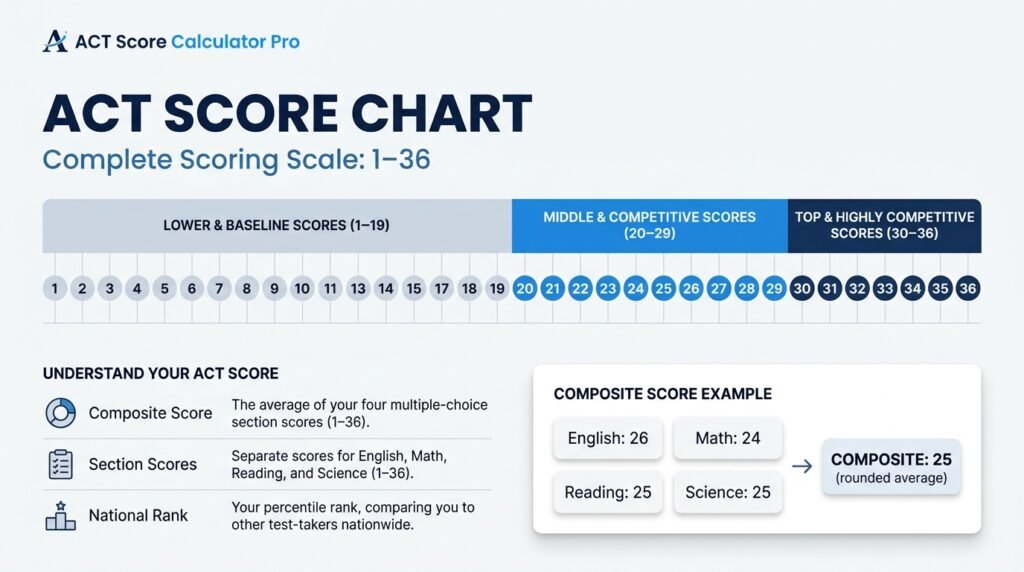
The ACT uses a scale of 1 to 36 for its multiple-choice section scores. Your Composite score is also reported on a 1–36 scale.
The table below shows the ACT Composite score and its national rank for the 2026–2027 reporting year. National rank represents the percentage of recent ACT test takers who earned that score or a lower score.
| ACT Composite Score | National Rank |
|---|---|
| 36 | 100 |
| 35 | 99 |
| 34 | 99 |
| 33 | 98 |
| 32 | 97 |
| 31 | 96 |
| 30 | 94 |
| 29 | 93 |
| 28 | 91 |
| 27 | 89 |
| 26 | 86 |
| 25 | 83 |
| 24 | 80 |
| 23 | 77 |
| 22 | 72 |
| 21 | 68 |
| 20 | 63 |
| 19 | 58 |
| 18 | 52 |
| 17 | 47 |
| 16 | 41 |
| 15 | 34 |
| 14 | 28 |
| 13 | 20 |
| 12 | 13 |
| 11 | 6 |
| 10 | 2 |
| 9 | 1 |
| 8 | 1 |
| 7 | 1 |
| 6 | 1 |
| 5 | 1 |
| 4 | 1 |
| 3 | 1 |
| 2 | 1 |
| 1 | 1 |
Important: These national ranks are for the 2026–2027 reference period, covering tests taken from September 2026 through August 2027. ACT updates its national rank tables periodically, so rankings may change in future reporting years.
Along with the overall ACT score chart, reviewing individual section scores can help you identify your academic strengths and areas for improvement.
What Is the ACT Composite Score?
The ACT Composite score is the overall score calculated from your required section scores. For tests taken in September 2025 or later, the Composite score is based on three sections:
- English
- Math
- Reading
Each section receives a score from 1 to 36. ACT calculates the average of these three scores and rounds it to the nearest whole number.
For example, if your section scores are:
- English: 26
- Math: 24
- Reading: 25
Your calculation would be:
(26 + 24 + 25) ÷ 3 = 25
Your ACT Composite score would be 25.
If the average ends in a fraction below 0.5, it is rounded down. If it is 0.5 or higher, it is rounded up.
You can enter your own section scores in our ACT Composite Score Calculator to calculate your result.
ACT Section Score Chart
ACT reports individual scores for its multiple-choice sections on a scale of 1 to 36.
| ACT Section | Score Range | Required for Current Composite? |
|---|---|---|
| English | 1–36 | Yes |
| Math | 1–36 | Yes |
| Reading | 1–36 | Yes |
| Science | 1–36 | No, optional |
| Writing | 2–12 | No, optional |
English, Math, and Reading determine the current Composite score. Science remains an optional section for eligible test formats and is reported separately.
The optional Writing test uses a different scoring scale, from 2 to 12. Its score does not affect the Composite score.
How to Read Your ACT Score
Your ACT score gives you an indication of your performance on the test. However, a score should be considered alongside your academic record, college preferences, and admission requirements.
Here are a few ways to interpret your result:
- Compare your score nationally: The national rank shows how your Composite score compares with scores earned by recent ACT test takers.
- Review individual sections: Your English, Math, and Reading scores can help identify subjects where you may benefit from additional preparation.
- Research college requirements: Check the middle 50% ACT score range published by each college you’re considering.
- Consider your goals: A score that is competitive for one college or program may be less competitive for another.
There is no single ACT score that guarantees admission. Colleges consider several parts of an application, and their testing policies and score expectations can differ.
Use the ACT score chart to compare your Composite score with national performance levels and understand where your results stand.
For a more detailed breakdown, see our guide to Good ACT Scores.
You can use this ACT score chart as a reference when setting your target score for college applications.
Current vs. Legacy ACT Scoring
ACT changed how it calculates the Composite score beginning in 2025. The date of your test determines which calculation applies.
| Scoring Format | Composite Calculation |
|---|---|
| September 2025 onward | Average of English, Math, and Reading |
| Before September 2025 | Average of English, Math, Reading, and Science |
For tests taken before September 2025, Science was included in the traditional four-section Composite score.
For tests taken in September 2025 or later, Science is no longer included in the Composite calculation. Students who take Science still receive a separate Science score.
This distinction is important when comparing scores from different test dates or using older ACT score reports.
Additional ACT Scores: STEM, ELA, and Writing
Besides the Composite and individual section scores, ACT may report additional scores depending on the tests you take.
ACT STEM Score
The STEM score represents performance in Math and Science. It is calculated by averaging the Math and Science section scores and rounding to the nearest whole number.
You need scores from both sections to receive a STEM score.
ACT ELA Score
The English Language Arts (ELA) score combines performance in English, Reading, and Writing. It is available to students who take the optional Writing test along with the required sections.
ACT Writing Score
The optional ACT Writing test is scored from 2 to 12. The score is based on four writing domains:
- Ideas and Analysis
- Development and Support
- Organization
- Language Use and Conventions
The Writing score is reported separately and does not contribute to your Composite score.
How Are ACT Raw Scores Converted to Scale Scores?
Your raw score is the number of questions you answer correctly in a test section. ACT converts this number into a scaled score between 1 and 36.
The conversion process helps maintain a consistent scoring scale across different ACT test forms. The number of questions and the difficulty of individual test forms can vary, so the same raw score does not necessarily produce the same scaled score on every test.
There is no penalty for incorrect answers.
For this reason, a universal raw-to-scaled score conversion chart may not accurately predict your official result. Your ACT score report provides the scaled scores calculated for your specific test.
Frequently Asked Questions About the ACT Score Chart
What is the highest possible ACT score?
The highest possible ACT Composite score is 36. Individual multiple-choice section scores can also reach 36.
What is the lowest possible ACT score?
The lowest reported ACT Composite score is 1. Individual multiple-choice section scores range from 1 to 36.
Is the ACT scored from 1 to 36?
Yes. English, Math, Reading, and Science multiple-choice scores use a 1–36 scale. The Composite score also ranges from 1 to 36. The optional Writing test uses a separate 2–12 scale.
How is the ACT Composite score calculated?
For tests taken in September 2025 or later, ACT averages your English, Math, and Reading scores and rounds the result to the nearest whole number.
Does Science count toward the ACT Composite score?
No. For tests taken in September 2025 or later, Science is optional and is not included in the Composite calculation. It can still contribute to your STEM score.
What does ACT national rank mean?
National rank indicates the percentage of recent ACT test takers who earned your score or a lower score. For example, a national rank of 77 means your score was equal to or higher than approximately 77% of the comparison group.
Are ACT score percentiles the same as national ranks?
ACT uses national ranks to show how a score compares with the performance of other test takers. These rankings are commonly described as percentiles. The comparison group and reporting year matter, so always check which reference table is being used.
For a more detailed comparison by section and score, visit our ACT Score Percentiles guide.
Can I calculate my ACT Composite score myself?
Yes. Add your English, Math, and Reading scores, divide the total by three, and round to the nearest whole number for tests taken in September 2025 or later.
You can also use our free ACT Score Calculator to do the calculation automatically.
Where can I find my official ACT scores?
You can view your official ACT scores through your MyACT account. Visit the official ACT website to sign in and access your score report.
You can also check our ACT Score Release Dates guide for information about when scores become available.
Official ACT Scoring Reference
The scoring details and 2026–2027 national ranks in this guide are based on information published by ACT. For the latest official tables and explanations, consult the ACT National Ranks and Percentiles page and Understanding Your ACT Scores.
ACT Score Calculator Pro is an independent educational resource and is not affiliated with, endorsed by, or sponsored by ACT.